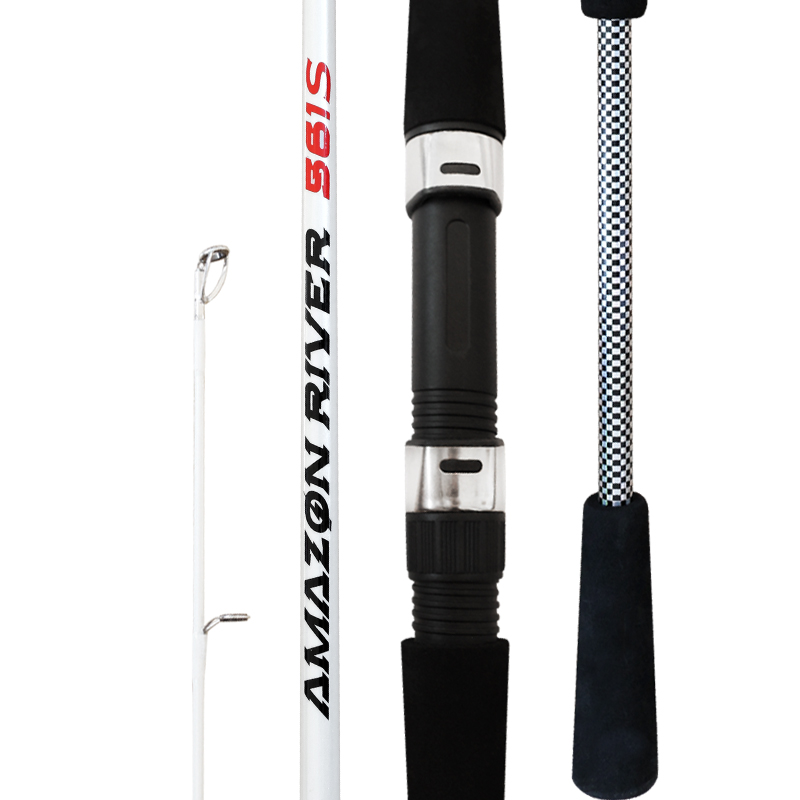
Casting ultra-light lures weighing between 1/32 oz and 1/8 oz often exposes the mechanical flaws in an angler's setup. When you attempt to throw tiny jigs or weightless plastics on standard tackle, the results are predictable: wind knots, abysmal casting distance, and a complete lack of tactile feedback. A standard medium-heavy setup simply lacks the kinetic energy transfer required to propel low-mass baits. Trying finesse techniques with the wrong rod directly causes missed strikes, compromised bait presentation, and frustrating line management failures.
To solve this, you need a technical framework for evaluating finesse-specific gear. Successful light-lure handling is a highly measurable combination of blank material, taper, load capacity, and component geometry. Understanding how these elements interact allows you to build a system that efficiently transfers energy, giving you total control over the lightest baits in your tackle box.
Key Takeaways
Action Dictates Trajectory: A fast or extra-fast action is critical for light lures, allowing the rod tip to load and unload rapidly to generate line speed without requiring heavy lure mass.
Power Determines Load: Ultra-light to light power ratings ensure the rod blank compresses adequately under the minimal weight of finesse baits.
Material Modulus Matters: A high-modulus carbon fiber fishing rod provides the necessary stiffness-to-weight ratio, maximizing sensitivity while minimizing the physical weight that dampens lure feel.
System Synergy is Required: The rod cannot function in isolation; guide spacing, line choice, reel gear ratio, and reel balance are mandatory variables for mitigating friction and maximizing casting efficiency.
The Physics of Finesse: Why Standard Setups Fail with Light Lures
Casting is fundamentally an exercise in physics. A fishing rod acts as a spring. To cast effectively, that spring must be compressed, or loaded, by the weight of the lure during the backcast. When the rod unloads, it transfers that stored kinetic energy into the lure, propelling it forward. If the lure lacks the mass to compress the blank, the spring mechanism fails entirely.
This creates a severe mass-to-compression deficit when using standard gear. A medium-heavy rod requires a lure weighing at least 3/8 oz to bend the upper third of the blank. Tie on a 1/16 oz hair jig, and the rod remains completely rigid. Because the rod fails to load, the angler instinctively forces the cast by swinging harder. This aggressive motion causes erratic lure flight, introduces slack line that forms loops around the guides, and ultimately reduces casting distance. You are essentially trying to throw a feather with a broomstick.
A successful setup reverses this deficit. The baseline criteria for handling light lures include effortless loading on the backcast, minimal line friction during the forward stroke, high vibration transmission to detect subtle bites, and sufficient backbone in the lower section for hook penetration. When the rod compresses easily under minimal weight, the angler can cast with a smooth, relaxed motion.
To achieve this, anglers must look at specific mechanical properties. You cannot just pick up any rod off the rack and expect it to throw a 1/32 oz Ned rig. You need a tool engineered specifically for low-mass energy transfer.
Core Evaluation Dimensions for a Lightweight Spinning Rod
Rod Action: The Catapult Effect
Rod action defines where the blank bends under pressure. For finesse applications, Extra-Fast and Fast actions are the industry standard. An extra-fast action means only the top 15 to 20 percent of the rod bends, while the rest remains stiff. This rapid taper allows the tip to load and unload instantly. It creates a catapult effect, generating high line speed and precise trajectory control without requiring heavy lure mass.
Moderate actions, which bend closer to the middle of the blank, present significant trade-offs. A moderate bend acts as a shock absorber, cushioning treble-hook baits and reducing the felt bumps when bouncing off rocks. However, this deeper flex sacrifices pinpoint casting accuracy. The slower recovery time of a moderate blank scatters the energy, making it difficult to shoot ultra-light lures under docks or overhanging branches.
Rod Power: Load Capacity and Hook Setting
While action dictates where the rod bends, power dictates how much force is required to bend it. Power is the blank's resistance to flexing. For light lures, anglers must choose between Ultra-Light (UL), Light (L), and Medium-Light (ML) power ratings.
| Rod Power | Optimal Lure Weight Range | Primary Applications |
| Ultra-Light (UL) | 1/64 oz - 1/16 oz | Micro-jigs, Trout Magnets, Hair Jigs |
| Light (L) | 1/16 oz - 1/8 oz | Drop-shot, Small Swimbaits, Wacky Rigs |
| Medium-Light (ML) | 1/8 oz - 1/4 oz | Ned Rigs, Shaky Heads, Light Texas Rigs |
Mapping lure weights to power ratings ensures system efficiency. Ultra-Light rods excel with the absolute lightest baits. Light power rods handle the middle ground perfectly. Medium-Light rods bridge the gap, managing slightly heavier finesse baits while providing enough backbone to drive single hooks into larger predators.
Softer power ratings also serve a mechanical function: shock absorption. Finesse fishing requires thin-diameter lines, often 4-pound or 6-pound test. A stiff rod will snap these fragile lines instantly during a violent hookset or a sudden surge from a fish at the boat. The softer power of a finesse rod flexes to absorb those sudden spikes in tension, protecting the line from breaking.
Material Science: The Role of the Carbon Fiber Fishing Rod
Blank Construction and Modulus Ratings
The foundation of any sensitive finesse setup is the blank material. Modern rods rely on carbon fiber, categorized by its tonnage or modulus rating. Modulus refers to the stiffness-to-weight ratio of the graphite fibers. A 24-ton carbon blank is durable and flexible but relatively heavy and dead in the hand. Moving up to 30-ton or 40-ton graphite drastically changes the rod's characteristics.
Higher modulus materials are stiffer, meaning manufacturers can use less material to achieve the desired power. This reduces the overall weight of a carbon fiber fishing rod. Less physical mass in the blank means vibrations from a ticking jig or a subtle strike travel faster and more clearly to the angler's hand. When fishing light lures on slack line, this heightened sensitivity is mandatory for detecting bites before the fish spits the hook.
Weight vs. Durability Trade-offs
The pursuit of extreme sensitivity introduces implementation risks. High-modulus blanks are inherently more fragile. The stiffer the carbon fibers, the more brittle they become under sheer stress. High-sticking a fish or banging the rod against a gunwale can easily shatter a 40-ton blank.
To mitigate this brittleness, manufacturers utilize advanced resin systems to bind the carbon fibers tightly, filling microscopic voids that could cause structural failure. Multi-directional wrapping techniques, such as X-wrap technology, reinforce the lower sections of the blank. This cross-wrapping adds hoop strength, preventing the blank from ovaling and crushing under heavy loads while maintaining the lightweight, sensitive tip required for finesse fishing.
Component Architecture: Guides, Handles, and Balance
Guide Sizing and Friction Reduction
The guides on a rod dictate how efficiently line travels from the reel to the tip. Guide material, such as Silicon Carbide (SiC) or Alconite, impacts both friction and weight. Heavy guides add mass to the rod tip, causing it to bounce after a cast. This bouncing, known as poor recovery speed, slaps the line against the blank and kills casting distance. Lightweight frames with hard, smooth inserts ensure the rod tip snaps back to straight instantly.
Micro-guides have revolutionized finesse rods. A spinning reel ejects line in wide coils. The first guide, known as the stripper guide, catches these coils. The subsequent guides must quickly funnel the line down to a straight path. The point where the line stops coiling and runs straight is the choke point. Micro-guides tame these coils faster, reducing wind resistance and maximizing the casting distance for low-mass lures on a lightweight spinning rod.
Handle Design and Tactile Feedback
Handle geometry directly impacts how vibrations transfer to the angler. Split-grip handles eliminate excess material between the reel seat and the butt, reducing overall weight and exposing more of the raw blank. Full-grip handles offer more surface area for two-handed casting but can dampen micro-vibrations.
Material choice also plays a role. High-grade cork is dense and transmits vibration exceptionally well, though it requires maintenance. EVA foam is durable and provides excellent grip in wet conditions, but softer foams can absorb subtle ticks. Regardless of the handle material, the reel seat must feature cutouts that expose the raw carbon blank. Direct finger contact with the blank is the most reliable way to feel a light bite.
Spinning vs. Baitcasting for Light Lures: A Technical Verdict
Solution Categories & Approaches
The debate between spinning and baitcasting gear for finesse applications comes down to mechanical efficiency. Baitcasting reels rely on a rotating spool to feed line during the cast. Spinning reels utilize a stationary spool, allowing the line to uncoil freely over the lip.
The Spool Inertia Problem
Baitcasters struggle with light lures due to the spool inertia problem. To execute a cast, the weight of the lure must pull the line hard enough to overcome the physical resting inertia of the metal spool. A 1/16 oz jig simply does not possess the mass to start the spool spinning efficiently. If the angler forces the cast, the rod tip generates initial speed, but the lure rapidly decelerates in the air. The spool, however, continues spinning at high speed, resulting in severe overruns and backlashes.
The Spinning Advantage
Because a spinning reel's spool does not rotate during the cast, there is zero startup inertia to overcome. The line simply falls off the spool as the lure pulls it. This frictionless deployment makes a Spining Rod the mathematically superior and infinitely more practical choice for throwing baits under 1/8 oz. While specialized Bait Finesse System baitcasters exist, they require expensive, ultra-shallow spools and highly tuned bearings to achieve what a standard spinning setup does effortlessly.
Implementation Realities: Optimizing Your Freshwater Spinning Rod Setup
Line Selection and Diameter
The best finesse rod is useless if paired with the wrong line. Thick lines create massive water drag and wind resistance, ruining the sink rate and action of light lures. The optimal approach is utilizing a low-diameter braided main line connected to a fluorocarbon leader.
Braid offers zero stretch, ensuring maximum vibration transmission and instant hooksets. For finesse applications, 4-pound to 8-pound braid is ideal. It casts smoothly through micro-guides and cuts through the wind. Attach a 2-pound to 6-pound fluorocarbon leader using a streamlined knot like the FG or Alberto knot. The fluorocarbon provides invisibility underwater and abrasion resistance against rocks and timber.
Reel Sizing, Gear Ratio, and System Balance
Pairing a lightweight rod with a heavy, oversized reel destroys the setup's fulcrum point. A balanced combo should balance perfectly on your index finger right at the reel seat. If the reel is too heavy, the rod tip points to the sky, forcing you to constantly push the tip down, causing wrist fatigue. For a freshwater spinning rod, stick to 1000, 2000, or compact 2500 series reels to maintain the center of gravity.
Gear ratio is another variable. Finesse fishing often involves working baits with the rod tip and reeling in slack. A faster gear ratio, such as 6.0:1 or 6.2:1, allows you to pick up slack line instantly. This speed keeps baits moving smoothly, maintains tension during a fight, and prevents fish from shaking out light-wire hooks.
Mount your chosen reel onto the rod and spool it with backing.
Fill the main spool with 8-pound high-visibility braided line.
Tie a 6-foot section of 4-pound fluorocarbon leader using an Alberto knot.
Thread the line through the micro-guides, ensuring no twists occur at the choke point.
Tie on a 1/16 oz jig head and test the balance point right above the reel seat.
Conclusion
Audit your current tackle box and weigh your most frequently used finesse lures to determine your exact power requirements.
Check the balance point of your current rod and reel combo; if it is bottom-heavy, downsize your reel to a 1000 or 2000 size.
Upgrade your line system to a thin-diameter braid with a fluorocarbon leader to instantly improve casting distance and lure sink rates.
Inspect your rod guides for heavy frames or cracked inserts that may be causing unnecessary line friction.
FAQ
Q: What is the difference between rod power and rod action for light lures?
A: Power refers to the rod's resistance to bending and its overall lifting strength, such as Ultra-Light or Medium-Light. Action dictates where the blank flexes. Fast action rods bend near the tip, while moderate actions bend closer to the middle. You need light power to load small lures and fast action to cast them accurately.
Q: Why can't I cast light lures with a medium-heavy spinning rod?
A: A medium-heavy rod is too stiff to compress under the weight of a 1/16 oz lure. Because the rod does not load, it cannot store and release the kinetic energy needed to propel the bait forward, resulting in short, inaccurate casts.
Q: Is a carbon fiber fishing rod better than fiberglass for finesse fishing?
A: Yes. Carbon fiber offers a much higher stiffness-to-weight ratio than fiberglass. It is significantly lighter and transmits vibrations far better, which is essential for feeling subtle strikes when fishing light lures on slack line.
Q: What is the best line to use on a lightweight spinning rod?
A: A thin-diameter braided main line (4 to 8-pound test) paired with a fluorocarbon leader (2 to 6-pound test) is optimal. Braid provides zero stretch for sensitivity and casts far, while the fluorocarbon leader adds invisibility and abrasion resistance.
Q: What size and gear ratio spinning reel balances best with a light power rod?
A: A 1000 to 2500 size reel balances best, preventing the setup from becoming bottom-heavy. A faster gear ratio, around 6.0:1 or higher, is recommended to quickly pick up slack line and maintain tension on light-wire hooks.
Q: How do micro-guides improve casting distance with light baits?
A: Micro-guides are smaller and lighter. They quickly tame the wide coils of line coming off a spinning reel, funneling the line into a straight path faster. This reduces wind resistance and line slap against the blank, increasing casting distance.

