Missed strikes frustrate every angler on the water. They often stem from poor energy transfer and a severe lack of leverage during the critical split-second of a hook set. You might immediately blame a dull hook or a delayed reaction time. However, the actual culprit frequently lies right in your hands. While line type and rod action capture most of our attention, the handle remains your sole physical connection to the rod blank. If your grip slips, compresses excessively, or poorly distributes torque, hook penetration will ultimately fail. We will evaluate various handle materials, lengths, and design styles strictly through the lens of hook-setting mechanics. By understanding how these specific elements interact, you can make an evidence-based purchasing decision to drastically improve your landing ratio.
Key Takeaways
- Leverage is paramount: Handle length acts as a fulcrum; longer rear grips improve two-handed hook sets for heavy cover, while shorter grips favor precision casting.
- Material dictates energy transfer: Dense materials like carbon fiber and premium cork transmit vibration better, creating a highly sensitive bass rod that allows for faster reaction times.
- Grip stability under stress: EVA foam offers superior wet-weather traction, preventing hand slippage during aggressive, high-torque hook sets.
- Blank integration matters: A continuous, single piece bass rod blank extending entirely through the handle design is non-negotiable for maximum hook-setting power.
The Mechanics of a Hook Set: How Handles Dictate Leverage
Every successful hook set relies on basic physics. It functions as a rapid transfer of kinetic energy. Your hands act as the pivot point, or fulcrum. The rod blank serves as the lever. When you swing, you force energy down the line. A poorly designed handle absorbs this energy. A well-designed handle directs it straight into the fish's jaw. You must maintain complete control over the fulcrum to maximize penetration force.
The Physics of Penetration
Kinetic energy must travel from your shoulders down to the hook point. The handle dictates how efficiently this energy moves. If your grip shifts even slightly, you lose power. Torque plays a massive role here. Your lower hand pulls the butt section toward your body. Your upper hand pushes the reel seat forward. This push-pull motion creates intense rotational force. The handle material and length determine how much torque you can actually apply. A proper Bass Rod maximizes this mechanical advantage.
Blank-Through Construction
You must establish a strict baseline requirement for any rod you buy. The handle must utilize blank-through construction. This means the carbon blank runs continuously through the entire grip. Some cheaper rods use two-piece handle joints. They glue a separate handle section to the main rod. These joints lose massive amounts of power during a hook set. They also create a weak point. When you swing hard, a segmented handle flexes independently. This flexing absorbs the exact kinetic energy you need for hook penetration. Always demand a continuous blank structure.
Weight Distribution and Balance
A perfectly balanced rod dramatically reduces wrist fatigue. Anglers often ignore handle weight. They focus solely on tip weight. However, the handle balances the entire rig. If a rod feels tip-heavy, your wrist works harder all day. Fatigue slows down your fast-twitch muscle response. When a strike occurs, you react milliseconds slower. A balanced handle places the center of gravity near the reel seat. You keep your muscles relaxed. You maintain maximum fast-twitch capability for explosive hook sets.
- Pivot Control: Your hands dictate the rotational force applied to the blank.
- Energy Retention: Continuous blanks prevent energy bleed during the swing.
- Muscle Readiness: Balanced handles preserve your reaction speed over an eight-hour tournament day.
Handle Materials Evaluated: Traction vs. Transmission
Manufacturers build grips from three primary materials. Each material offers distinct advantages and drawbacks. You must weigh grip security against vibration transmission. Your choice directly influences how quickly you detect a bite and how firmly you drive the hook.
Premium Cork (Traditional & High-Density)
Premium cork remains a staple in the fishing industry. It offers excellent resonance for bite detection. The cellular structure of natural cork transmits high-frequency vibrations efficiently. You feel subtle ticks easily. Over time, natural compression allows the cork to conform to your hand shape. This creates a custom ergonomic fit.
However, cork carries distinct disadvantages. It can become incredibly slick. When coated in fish slime, it loses traction. Heavy rain also compromises grip security. If your hand slips during a forceful set, you lose the fish. Lower-grade cork features excessive filler. This filler crumbles under pressure and dampens sensitivity.
EVA Foam (High-Density Ethylene-Vinyl Acetate)
EVA foam prioritizes pure traction. It delivers maximum grip security in brutal wet conditions. Foam compresses slightly under pressure. This compression locks your fingers into place. It proves essential for heavy-cover flipping. Flipping requires the highest torque of any bass technique. You need absolute grip stability to drag a fish through thick vegetation.
The drawback involves vibration dampening. Lower-density foams absorb subtle vibrations. They act like shock absorbers. This slightly reduces the tactile feedback of a sensitive bass rod. To counter this, manufacturers now use high-density EVA. High-density versions improve transmission while retaining wet-weather grip. Always check the foam firmness before buying.
Carbon Fiber Monocoque and Carbon Grips
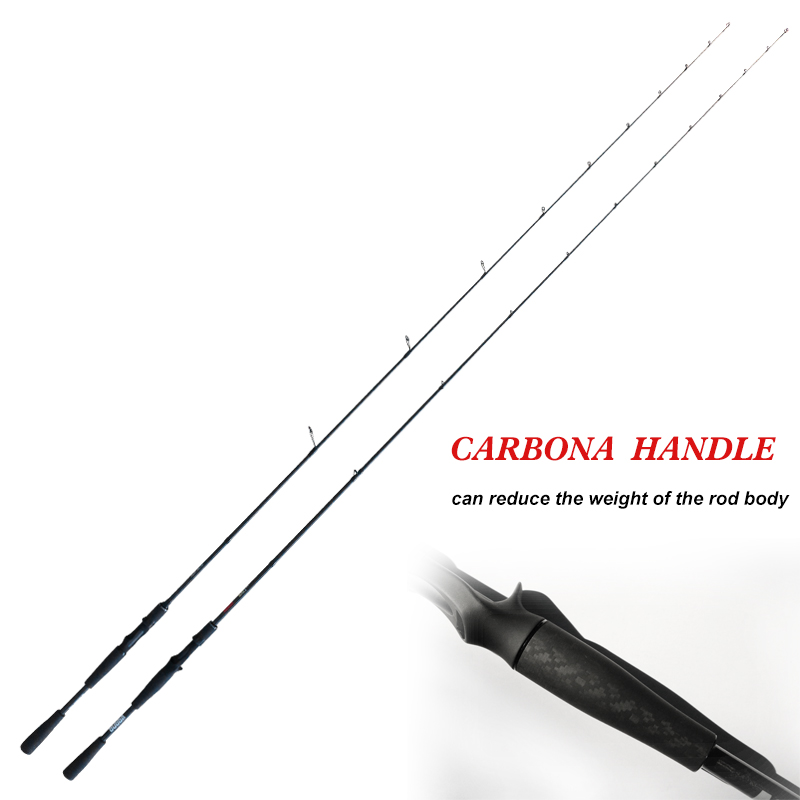
Carbon fiber handles represent the peak of modern rod design. They offer unmatched vibration transmission. They pair perfectly with a high-modulus carbon fishing rod. This combination amplifies subtle bites loudly. You react faster because you feel the strike instantly. A carbon grip utilizes a rigid hollow structure. It wastes zero kinetic energy during the hook set. Every ounce of force transfers directly to the hook.
Despite these benefits, carbon grips have limitations. They can feel overly rigid. Prolonged cold-weather use makes them uncomfortable. They lack the natural warmth of cork. Furthermore, they require precise ergonomic sizing. If the diameter does not fit your hand, you will experience cramping.
Split-Grip vs. Full-Grip: Which Translates to Better Penetration?
The debate between split-grip and full-grip designs confuses many anglers. Both styles serve specific biomechanical purposes. Your choice depends entirely on how you swing the rod.
Full-Grip Designs
Full-grip models provide a continuous surface area behind the reel seat. You can place your hands anywhere along the handle. This varied hand placement accommodates different casting angles. You gain massive surface area for bracing the rod.
This design excels at high-leverage, two-handed hook sets. Think about throwing heavy jigs or dragging Carolina rigs. You sweep the rod aggressively. A full grip offers maximum stability against your forearm. It will not dig into your ribs. It disperses the pressure evenly across your arm. When you drive a thick-wire hook home, you need this bracing support.
Split-Grip Designs
Split-grip models remove material between the reel seat and the butt. This exposes the raw rod blank. It reduces overall rod weight noticeably. Manufacturers trim unnecessary mass to improve balance. This design caters directly to finesse anglers.
Split-grips are ideal for single-handed hook sets. They dominate techniques like drop-shotting and shaky head fishing. The exposed blank allows direct finger contact. Direct contact dramatically improves bite detection. You feel the terrain changes and subtle pickups. However, this design sacrifices a degree of two-handed leverage. You lack the continuous bracing surface against your forearm.
The Role of Handle Length in Hook-Setting Torque
Handle length acts as the physical lever for your hook set. It dictates how much torque you can generate safely. Anglers often buy rods based on overall length. They completely ignore the rear grip measurement. This mistake costs them fish.
Short Handles (Under 9 inches)
Short handles excel in tight quarters. They suit roll-casting perfectly. They also dominate topwater walk-the-dog techniques. You can twitch the rod tip continuously. The short butt sections clear your clothing easily. They do not snag on your jacket.
The hook set impact presents a challenge. Short handles rely heavily on a quick wrist-snap. You depend on the rod taper rather than pure leverage. You face a high risk of torque loss on long casts. If a fish strikes far away, you lack the leverage to move enough line quickly.
Mid-Length Handles (9 to 11 inches)
This serves as the standard utility length. Most all-purpose bass rods feature this measurement. It balances casting accuracy with hook-setting power. You can throw spinnerbaits, chatterbaits, and medium crankbaits effectively.
The mid-length handle impacts your hook set positively. It allows the butt to tuck firmly under your forearm. This provides critical stability during the swing. It generates enough torque for medium-wire hooks. Importantly, it still clears bulky winter clothing during the cast.
Long Handles (12+ inches)
Long handles are built for extreme power. They handle punching, deep cranking, and heavy swimbaits. You need maximum leverage for these heavy-duty applications. You often pair them with heavy braided line.
Their impact on the hook set is undeniable. A long handle anchors firmly into your ribs. You can also tuck it deep under your armpit. It delivers maximum leverage. You can drive heavy-gauge hooks home effortlessly. It pairs exceptionally well with a stiff, single piece bass rod. The extended lever magnifies your pulling force exponentially.
- Measure the rear grip from the back of the reel seat to the butt cap.
- Test the clearance by swinging the rod while wearing a fishing jacket.
- Ensure the butt cap anchors securely under your arm for heavy techniques.
Matching Handle Design to Technique and Rod Blank (Decision Framework)
You cannot blindly choose a handle based on aesthetics. You must match the grip strictly to your intended technique. Different lures demand different biomechanical motions.
For Flipping and Pitching (Heavy Cover)
You target thick grass mats and laydown trees. You use heavy tungsten weights and stout hooks. You need raw power to extract the bass quickly.
Shortlist: You want a long handle exceeding 11 inches. You need EVA foam material. You should select a full grip design.
Why: This combination prioritizes a non-slip grip. You gain maximum forearm leverage. You must cross the fish's eyes instantly. A foam full-grip gives you the bracing support needed to pull the fish straight out of dense cover.
For Finesse and Drop-Shotting (Light Line)
You target highly pressured fish in clear water. You use light fluorocarbon line and small, thin-wire hooks. You rely on stealth and sensitivity.
Shortlist: You want a mid-to-short handle. You should select carbon fiber or premium cork. A split-grip design works best.
Why: This setup prioritizes extreme sensitivity. Feeling the bite instantly dictates your hook-set timing. Brute force will snap your light line. You rely on quick reaction speeds. The split-grip reduces weight and enhances vibration transfer.
Implementation Risk (Buyer Beware)
You must inspect the transition between the reel seat and the handle material. Avoid handles where the reel seat feels disconnected. Check for any gaps or excessive glue lines. Micro-shifts under pressure will bleed your hook-setting power. If the grip twists even slightly in the store, do not buy it. It will fail under the load of a large bass.
Handle Design Decision Matrix
| Technique Profile | Ideal Material | Grip Style | Handle Length | Primary Benefit |
| Heavy Cover Flipping | High-Density EVA | Full-Grip | 11+ Inches | Maximum leverage and wet-weather traction. |
| Deep Cranking | Premium Cork / EVA | Full-Grip | 12+ Inches | Rib anchoring for reduced fatigue on the retrieve. |
| Finesse / Drop-Shot | Carbon Fiber / Cork | Split-Grip | Under 9 Inches | Instant vibration transfer and reduced weight. |
| All-Purpose Casting | Cork / EVA Blends | Split or Full | 9 to 11 Inches | Versatility across multiple lure weights. |
Conclusion
No single magic bullet exists in rod design. The "best" handle configuration depends entirely on your specific technique and the gauge of the hook being driven. You must stop treating the handle as a cosmetic afterthought. It serves as your primary control interface during the fight.
For raw power and secure wet-grip performance, choose EVA full-grips. For pure reaction speed and maximum vibration transfer, prioritize carbon fiber or premium cork split-grips. Always consider the biomechanics of your specific fishing style before making a purchase.
Take proactive next steps. Visit a tackle shop and mount your exact reel on the rod. Simulate a forceful sweeping hook set. Check if the handle length cleanly clears your torso. Ensure the grip feels secure and balanced. Testing the rig in person guarantees you match the right tool to the right job.
FAQ
Q: Can a handle design compensate for a slow-action bass rod during a hook set?
A: No. While a long handle provides excellent leverage, a slow-action rod still absorbs too much energy. The blank bends deeply before moving the hook. You must pair your handle design with a fast or extra-fast taper. This precise combination guarantees optimal hook penetration and prevents lost fish.
Q: How do handle designs affect hook sets on light-power finesse rods?
A: Light rods demand a different approach. Hook sets rely on a smooth reel sweep and sharp tip loading. Brute leverage matters less here. A lightweight split-grip serves as the optimal choice. It reduces tip-heaviness and improves balance. This design speeds up your physical reaction time significantly.
Q: Does an exposed blank reel seat improve hook setting?
A: Indirectly, yes. An exposed design allows direct finger contact against the carbon blank. You feel vibration instantly. You detect strikes fractions of a second earlier. This early detection enables a preemptive response. You position yourself perfectly and execute the hook set before the bass ejects the lure.

