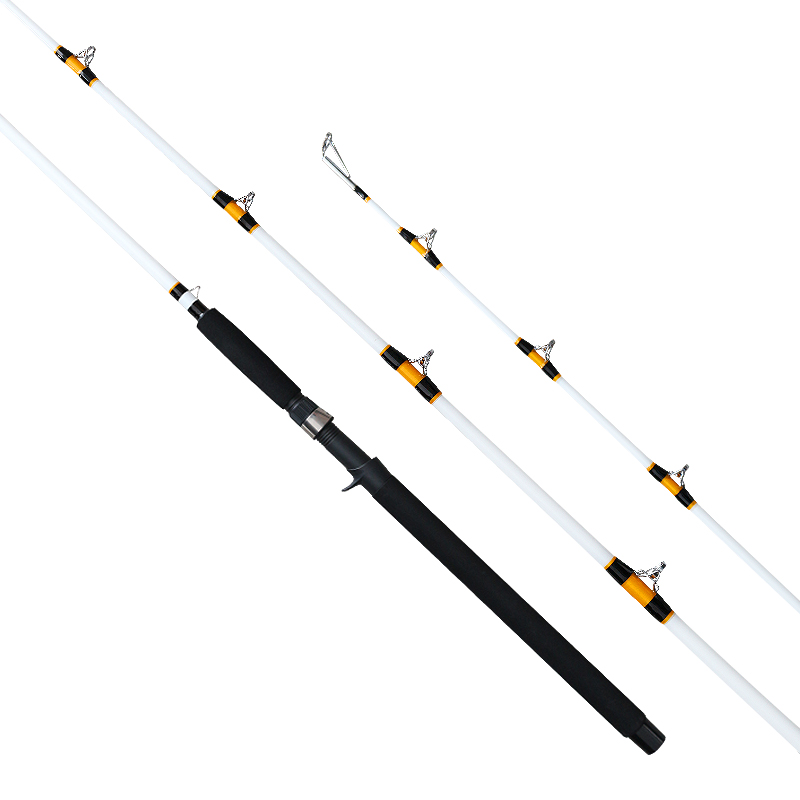
Graphite vs fiberglass vs composite: what the material changes on a Fishing Rod
Before we talk distance, you need to understand what graphite changes in a Fishing Rod. Most modern rods are built from three broad material families:
Graphite (often called carbon fiber) is valued for being light and responsive. Fiberglass is tougher and more flexible but usually heavier and slower to recover. composite blanks aim to blend graphite sensitivity with fiberglass durability.
Why weight matters for casting distance
Casting distance is partly about tip speed. A lighter Fishing Rod is easier to accelerate. If your rod is heavy, your casting motion slows down and the rod may “lag,” reducing line speed. Graphite is typically lighter than fiberglass at the same power rating, so an angler can generate higher tip speed with less effort, especially over many casts.
Why recovery speed matters for casting distance
When you cast, the Fishing Rod bends (loads) then springs back (unloads). A graphite Fishing Rod often recovers faster—meaning it stops wobbling sooner. Less wobble means less energy wasted. More energy goes into launching the lure forward instead of vibrating the blank. That cleaner energy transfer is a major reason a graphite Fishing Rod can increase casting distance.
Does a graphite Fishing Rod always cast farther?
Not always. A graphite Fishing Rod can cast farther, but only when these conditions are true:
Your lure weight matches the Fishing Rod’s intended range
The Fishing Rod length fits your fishing environment
The Fishing Rod action loads smoothly with your casting style
Your line, guides, and reel setup reduce friction and line issues
Your technique is consistent enough to take advantage of the blank
If any of these are off, a graphite Fishing Rod might feel great (light, sensitive) but won’t automatically add distance.
The physics in plain English: how a Fishing Rod generates distance
Distance comes from energy transfer:
You apply force through your arms and wrists
The Fishing Rod stores energy by bending (loading)
The Fishing Rod releases energy by straightening (unloading)
The line flows through guides, and the lure launches
Graphite helps because it can store and release energy efficiently with less “energy loss” through blank vibration. But you still need the right Fishing Rod length and action to load the rod properly.
Fishing Rod length: the biggest distance multiplier
Even with the best graphite, Fishing Rod length is still the most obvious distance factor. Longer rods create more leverage and higher tip speed, which usually helps casting distance.
Distance-friendly length guideline
Short Fishing Rod (5’6”–6’3”): accurate, limited distance
Mid Fishing Rod (6’6”–7’3”): versatile, strong distance for most fishing
Long Fishing Rod (7’6”–9’+): maximum distance, less convenient in tight spots
Surf Fishing Rod (9’–13’+): designed for long casts beyond breakers
A graphite Fishing Rod in a longer length can be especially helpful because the material keeps weight manageable. Long rods can feel tiring; graphite reduces that fatigue so you can maintain a fast casting tempo.
Fishing Rod action: fast recovery can mean longer casts
Action affects how the Fishing Rod loads and how cleanly it releases energy.
Fast and Extra-Fast actions bend mostly near the tip and often recover quickly
Moderate actions bend deeper and can sling some lures very well, especially moving baits
Slow actions bend deep and can be very forgiving but may feel “soft” for distance
A common distance pattern:
If you’re throwing lighter lures, a faster graphite Fishing Rod can snap the lure out with a clean release
If you’re throwing heavier lures, a moderate-fast graphite Fishing Rod can load deeper and “catapult” the lure smoothly
The key is matching the action to the lure weight so the Fishing Rod loads properly.
Graphite grades: what IM7 Carbon and 30T Carbon mean for distance
Many shoppers see labels like IM7 Carbon or 30T Carbon and wonder if it’s marketing. While different brands vary, these terms usually point to blank material grade and stiffness-to-weight characteristics. A higher-performance graphite blank often feels:
Those traits can improve casting distance because you can accelerate the Fishing Rod more easily and waste less energy in vibration. But again, the rating has to match your lure range.
Components that support casting distance on a Fishing Rod
Even with graphite, poor components can steal distance. Here are the biggest “distance helpers” that need to align with your Fishing Rod:
Guides: stainless steel + ceramic inserts reduce friction
High-quality guides reduce friction and protect the line. Features like stainless steel guides and ceramic inserts are commonly used because they allow smoother line flow, which can improve distance and reduce heat and wear.
Handle comfort: EVA foam grip helps you cast longer
Casting distance isn’t only about one cast—it’s about consistency over time. A comfortable grip like EVA foam grip reduces hand fatigue so your casting stroke stays strong and consistent.
Reel smoothness affects line flow
A reel with smooth operation makes line flow more predictable. Many reels highlight 5+1 ball bearings for smooth retrieve and stability. While bearings don’t directly “add distance,” smoother line flow reduces the small inconsistencies that shorten casts.
Drag matters for distance indirectly
Drag systems like multi-disc drag don’t change cast length, but they improve the overall control of the combo. A stable drag helps you fish lighter lines confidently, and lighter line often casts farther with the same Fishing Rod because it reduces air resistance and friction.
Graphite Fishing Rod + reel pairing: why balance matters
A graphite Fishing Rod is often lighter than fiberglass. That’s great, but it means your reel choice changes balance more noticeably. If the reel is too heavy, the combo feels clunky. If it’s too light, the Fishing Rod may feel tip-heavy.
Balanced combos help distance because:
Your casting motion stays smooth
You can accelerate the Fishing Rod faster
You fatigue less over time
For travel anglers, pairing a graphite or carbon fiber blank with a compact reel and a carry box is a common modern approach, especially when the Fishing Rod is telescopic.
Telescopic graphite Fishing Rods: can they cast far?
A telescopic Fishing Rod can cast well, and graphite makes it lighter and easier to swing. But telescopic designs add joints, and joints can slightly affect energy transfer and recovery. The real advantage is portability: you can bring a longer Fishing Rod length to places you otherwise wouldn’t—potentially increasing distance simply because you’re using a longer rod.
To maximize distance with a telescopic graphite Fishing Rod:
Ensure the sections lock firmly with no looseness
Use quality line and smooth guides
Match lure weight carefully so the rod loads efficiently
Data analysis table: what most influences casting distance
This table summarizes the main drivers of casting distance and how graphite affects each factor.
| Factor | Impact on distance (Low/Med/High) | How graphite helps a Fishing Rod | What you should do |
| Fishing Rod length | High | Longer rods stay manageable because graphite is lighter | Choose the longest Fishing Rod you can comfortably use |
| Lure weight match | High | Graphite loads crisply when matched correctly | Stay in the Fishing Rod’s lure rating range |
| Fishing Rod action/recovery | Medium-High | Faster recovery reduces energy loss | Pick fast or moderate-fast based on lure type |
| Guide quality | Medium | Smooth line flow works better with responsive blanks | Look for stainless steel guides + ceramic inserts |
| Line choice | Medium | Light lines benefit from low-friction setups | Use appropriately thin line for your target fish |
| Reel line management | Medium | Smooth systems reduce line slap/tangles | Consider reels marketed with 5+1 ball bearings |
| Technique | High | Graphite rewards clean timing | Practice consistent loading/unloading |
Practical steps: how to get more distance from your graphite Fishing Rod
If you already have a graphite Fishing Rod, these steps often add distance faster than buying new gear:
Check lure weight: If your lure is too light or too heavy, your Fishing Rod won’t load correctly.
Use a longer leader or adjust line: Lighter line can improve distance, but stay safe for your fish size.
Inspect guides: Damaged ceramic inserts or bent stainless steel guides reduce distance and destroy line.
Improve casting tempo: Smooth acceleration loads the Fishing Rod better than a sudden “whip.”
Balance the combo: Pair your Fishing Rod with a reel that doesn’t make it tip-heavy.
For saltwater: Rinse after saltwater trips so the reel and guides stay smooth for future casts.
FAQs
Can a graphite Fishing Rod really improve casting distance?
Yes. A graphite Fishing Rod can improve casting distance because it is often lighter and recovers faster, allowing better energy transfer and higher tip speed. The improvement is biggest when the Fishing Rod length, action, and lure weight are properly matched.
Why does my graphite Fishing Rod not cast farther than my old rod?
Usually the issue is mismatch: lure weight too light/heavy, Fishing Rod action not loading well, poor line choice, or friction from guides. Even a high-quality graphite Fishing Rod won’t add distance if it can’t load efficiently.
Is carbon fiber the same as graphite in a Fishing Rod?
In many fishing contexts, graphite and carbon fiber are used interchangeably to describe carbon-based blanks. The key idea is a lightweight, responsive blank that can transfer energy efficiently.
Do guide materials affect casting distance?
Yes. Smooth guides reduce friction and improve line flow. Features like stainless steel guides and ceramic inserts help a Fishing Rod cast more efficiently and protect line.
Does a telescopic graphite Fishing Rod cast as far as a one-piece rod?
A telescopic graphite Fishing Rod can cast very well, but joints can slightly reduce recovery efficiency compared to one-piece rods. However, portability may let you use a longer Fishing Rod, which can increase distance in real-world conditions.

